
If this want to learn this for free and accelerate your business growth, then subscribe to this channel and press that bell icon to never miss any videos we upload.
Welcome to the channel EdEarn. I am Nitesh Khatiwada and we are starting right now.
“What’s invented within 20 years will disappear now and what’s invented now will disappear in 20 Years. But Old that still exists will continue to exist in years to come.” -Robert Kiyosaki
“Information doubles every 18 months.” -Moore’s Law
When we combine both of these quotations, we get something like this,
Old theories and practices will always show us some way forward, however, the implications of those theories and practices may vary over time. In 18 months to be exact. That is to say, the implications of the theories that we have found out before 18 months have changed now and we need to find a new implication for the same.
For Example, human emotions and things that manipulate them have remained relatively same over the ages but the medium to manipulate has changed over time. So, previously companies used magazines, newspaper, radio or television. Now, it is done through twitter, Facebook, Instagram, TikTok and other similar platforms. Here, take human emotions like an old theory and the platforms as changing implications.
- Economics Basics
If you have $1000 with you right now, what would you purchase. Please mention it in the comment section.
Let’s take an example, you have $1,000.00 with you and you have three things you want. One is to purchase a mobile phone; another is to purchase a laptop and finally go on a vacation. Each of these costs you $1,000.00 Now you have to choose to purchase one of those because you have limited resource i.e. money. Economics involves the choices people make when matching their limitless needs and wants with scarce resources.
You are getting this right?
The word “economics” is derived from the Greek words “oikos”, which means house, and “nomos”, which means manager. So, the term originally referred to the management of the household or individual unit. In other words, it was a microeconomics study. Today, the term has been broadened to refer to not only micro but also macro-economics. Hence, it applies to a larger portion of today’s transaction.
Another way of looking at economics is to consider the field as a set of tools for analysing people and groups and the choices that they make. Like, accountants render an account of financial activity for a company and lawyers contain certain mode of thinking to resolve issues in a legal framework, economists use set of tools and principles to analyse why individuals, firms, governments and other groups behave as they do. And analysing people and their practices is something we do regularly. Hence, each one of us is an economist from that point of view. Do you agree?
If you have any confusion regarding this section, feel free to leave it in the comment. You will have your confusion cleared.
2. Micro-Economics
In this section, we will briefly introduce you to Microeconomics.
Micro-economics deals with four fundamental analysis of the market. It includes:
- Demand and Supply: The determination of demand and supply of goods and services and the resulting equilibrium that leads to the determination of equilibrium market price and quantity. Further, the study of the concepts of elasticity, which measures the degree of reaction of people towards changes in the prices of goods and services are also the subject matter under this concept.
- Production Theory: The production function defines the relationship among various inputs and the maximum quantity of a good that can be produced. It is concerned with the allocation of scares inputs for maximum output. The concepts of isocost, isoquant and budget line are the major focus of the study. Managers study production functions to gain insights into the firm’s cost structure.
- Cost of Production: The concepts of total, fixed and variable cost are studied in cost of production concept. These costs drive the quantities of resources, their combinations and techniques used in production. This eventually determines the prices of goods and services offered by a firm.
- Labor Economics: Labor markets or job markets function through the interaction of workers and employers. Labour economics looks at the suppliers of labour services (workers) and the demanders of labour services (employers) and attempts to understand the resulting pattern of wages, employment, and income.
3. Macroeconomics
In this section, we will introduce you to Macroeconomics in brief.
Macroeconomics is a branch of the economics that studies how the aggregate economy behaves. It deals with the structure, performance, behaviour and decision-making of the whole, or aggregate, economy instead of focusing on individual markets.
A variety of economy-wide phenomena is thoroughly examined by the use of tools and techniques of macroeconomics such as inflation, price levels, rate of growth, national income, gross domestic product and changes in employment level.
With that clarity about micro and macroeconomics, let’s see the relationship between them and understand how micro and macroeconomics are related and both of them combined helps in making rational decisions. This analysis is equally important to any types of business.
4. Relationship between Micro and Macro Economics
Macro and Micro Economics are closely related to each other as factors studied in both microeconomics and macroeconomics typically influence one another.
For example, the unemployment level in the economy as a whole affects the supply of workers from which a company can hire. If the demand of employee with particular skill in the market is high relative to its supply (macroeconomics), a company can expect the cost of hiring an individual with similar skill to be high and vice versa (microeconomics).
Yes, or yes?
Rate of inflation helps to predict the future cost of production and make the necessary adjustment in the price of products. If the cost of raw materials grows at 3 per cent annually, a related company can make timely price adjustment so that real incomes are not degraded. Further, it may be more suitable to invest in an individual firm (microeconomic factor) of countries with higher economic growth (reflected by macroeconomics) than those with lower economic growth.
Are you with me?
If you have any questions regarding this section, feel free to leave it in the comment below.
5. Managerial Economics
Now, let us discuss in short about managerial economics and how it is useful to the managers.
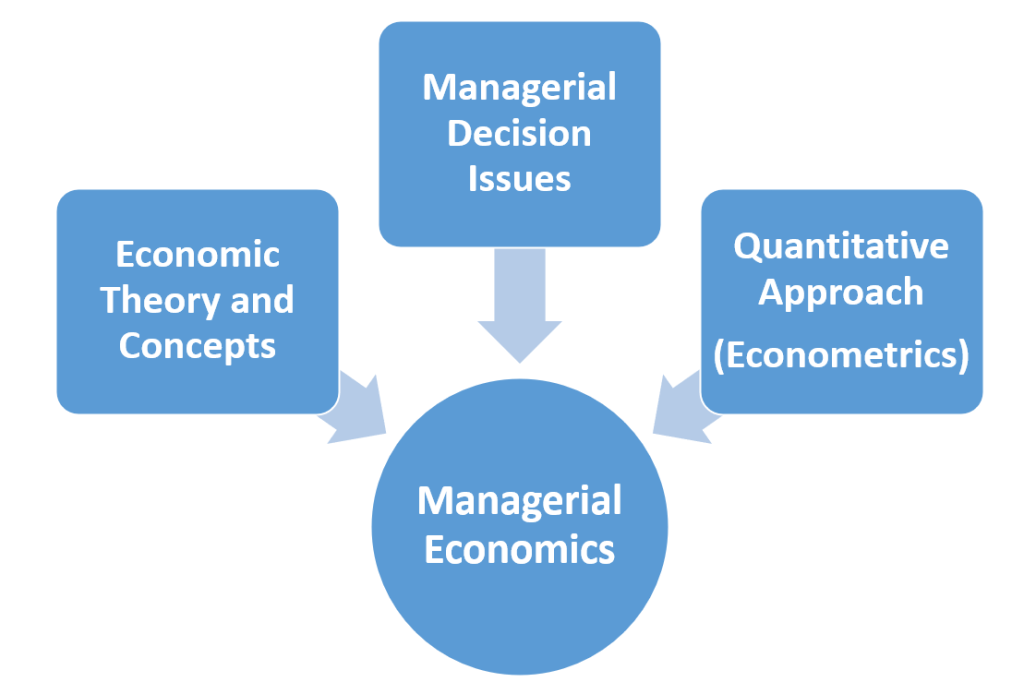
Managerial economics deals with the application of the economic concepts, theories, tools and methodologies to solve practical problems in a business. It helps the manager in decision making and acts as a link between practice and theory.
Managerial economics focuses on the microeconomics factors that are used in the decision-making process within an organisation. Managerial economics principles guide how and why corporations make certain decisions. Thus, assist the managers of a firm in a rational solution to obstacles faced in the firm’s activities.
Do you think your daily decisions are driven by a rational process? Please comment below.
It makes use of statistical and analytical tools to assess economic theories in solving practical business problems. Managerial economics is particularly accessed while making strategic decisions that can result in a profit or loss.
Thank you for staying till the end of today’s topic. See you in the next topic coming week.
If you have any comments, suggestion, confusion or questions, feel free to comment below.

